The other in my writing class, we were talking about awkward sentences, redundancies, and wordiness. Students tend to write things like, “the daughter of my sister” when perhaps they could’ve written “my sister’s daughter” or even “my niece.” Not to mention the number of times they’ll write “always” or “very” on one page.
A few days before, we’d talked about description, the famous dictum “show, don’t tell,” and specificity. Maybe instead of writing, “She drove a car,” write “She drove a yellow Volkswagen Beetle with a cracked windshield.”
Students then end up stuck between the rock of “don’t be wordy” and the hard place of “add specific details.” Maybe there is a time when you want to write “the daughter of my sister drove a car.” Story sentences tend not to be free floating, after all. They’re in a context. There’s rhythm and flow. There’s style.
Sensing that my students may have been feeling some consternation at my apparent conflicting advice, I decided to explain it using home decorating.
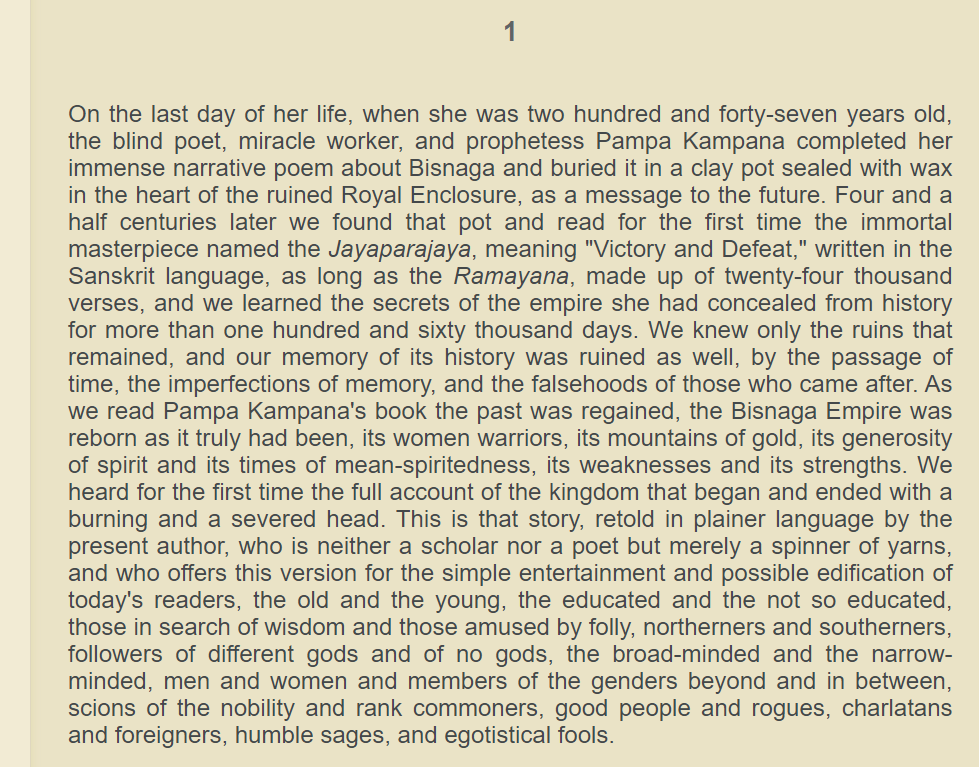
Well, first on the classroom computer I pulled up some stories. I went with the first ones that came to mind–an excerpt from Salman Rushdie’s Victory City and Ernest Hemingway’s Hills Like White Elephants. Victory City is lush with description. The opening sentences got everyone’s attention.
Here are the screenshots I showed the class, comparing the density of one and the white space of the other.

But what about that home decorating?
I pulled up pictures of maximalist and minimalist rooms. (I’m a sucker for coming up with analogies on the fly, for better or worse.) You can decorate as a maximalist or a minimalist. Either is fine. You might prefer one over the other (my students were not fans of the maximalist rooms–my favorite, of course), and not everyone who sees the room you design is going to like it. Also fine. The point is, you have thoughtfully put things in way that shows the world something about who you are. Maximalism is not just a bunch of stuff hurled into piles every which way.
Here I showed a picture of a disastrous room of hoarding. Hoarding is a whole other topic on which I have opinions, but rightly or wrongly, it helped illustrate my point.
No description is an empty room. There’s no sense of where the characters are or when.
A bit of description, strong but sparse lines, convey a lot. They get a more attention because they’re not battling with a thousand other things. This is your minimalist room.
A maximalist room is bursting with the description. The eye delights in the many things to find. On the first read through, you miss things you don’t find until you come back and read it again.
And whatever your thoughts are on hoarding, there’s definitely a feeling most of have when we see a space that is overly stuffed with no rhyme or reason. It doesn’t look thoughtful. It doesn’t look done with love. It looks like a problem. This is throwing words on the page and refusing to delete or rearrange or deal with in any way.
All of these styles have their place.
Know what you want. And have fun with it.
 Marta Bacon